Your shopping cart is currently empty.




About Instruments
The southeast's largest selection of new and used Band and Orchestra Instruments...and family favorite for information, service and lessons!
To start, click on the family of instruments you'd like to know more about or keep scrolling. You'll also find information on accessories and cleaning tips to make your music-making adventure easier and more fun.
String
Basics
 Basics about: violins, violas, cellos, and basses.
String instruments produce sounds when plucked, bowed or struck (sometimes called "hammered"). The basic styles of these instruments have not changed in the last 300 years.
Today's manufacturers, however, have been innovative in finding ways to make learning easier for beginners. For example, there are a number of different sizes to fit the physical capabilities of individual students. Your music instructor can help you identify the size instrument your child needs. For very young students, manufacturers create instruments with durability in mind.
How are different sounds and notes made?
In string instruments - violins, violas, cellos, and basses - a bow is drawn across the strings to create vibrations. These vibrations travel to the "bridge" (the part of the instrument that holds the strings). The musician controls the pitch of each note by knowing which strings to vibrate and when to stop the vibration (by holding the string against the fingerboard). Notes can also be "plucked" (the strings pulled).
Accessories
Your music instructor may recommend some accessories. The following are just a few of the accessories available at Portman's Music. We can help you learn what you may need and how to use them.
For all string instruments: humidifiers, mutes, pitch pipes (tuners), polishing cloths, rosins, and shoulder rests.
Shoulder rests: Shoulder rests help to reduce the amount of pressure a player needs to exert to hold the violin. Padded shoulder rests also are more comfortable. They come in a variety of styles and sizes.
Rosin: Rosin is applied to the bow to allow the horsehair to grip the strings. Be careful - too much rosin can have a negative effect on the sound. It is a good idea to have your orchestra instructor show how to properly apply rosin.
Polishing cloths: Polishing cloths are used to polish instruments to remove fingerprints and rosin dust.
Mutes: Mutes are to quiet the vibrations of the strings.
Humidifiers: Humidifiers are used to humidify the wood of a stringed instrument. It is placed inside the instrument, and is designed to prevent cracking and separating of wood during dry conditions.
Endpin rests (for cellos and basses only): Endpin rests are usually foam rubber disks that hold a reinforced brass cup for the endpin of a cello or bass. It keeps the instrument from sliding around, and it protects the floor from damage.
Cleaning
Every time you play:
- Rosin your bow with a few sweeps across the cake of rosin. Initially, your bow will require more rosin than it does once you have been using it a while.
- Check the tuning of your strings using the pitch pipe or matching the other members of your group. Get close with the tuning pegs and then make small adjustments with the fine tuners.
- After you play, wipe the fingerboard, strings, and bow stick with the cleaning cloth to remove rosin dust. Loosen the bow before you put it back in the case.
Every few weeks:
- Loosen your fine tuners all the way and retune the strings using the tuning pegs, checking against the pitch pipe.
Every six month:
- Replace your strings with a new set. Never remove all the strings at once; replace them one at a time.
Every year:
- Bring your instrument in to Portman's Music for an annual check.
General tips:
- Be careful not to store music or supplies over the instrument in the case. Store them in accessories pocket or a separate bag.
- Never touch the bow hair or the strings of the instrument with your fingers.
- If possible, keep a spare set of strings on hand in case one breaks. To prevent breakage, avoid tuning a string above its intended pitch.
Percussion
Basics
 Basics about drums (bass, snare and timpani), marimbas, xylophones and cymbals.
The percussion family is the largest, oldest and most diverse family of musical instruments. Percussion instruments are played by striking a drumhead, bell or bar with a stick, mallet, or the hands.
Some important members of the percussion family:
The bass drum is the largest and lowest pitched drum in the band or orchestra. It is important because it keeps the rhythm for the rest of the instruments. The snare drum is much smaller than a bass drum and is higher in pitch. It has a "snare" which vibrates against the bottom head to create a very distinctive sound. Drum students will learn many basic "sticking" techniques on a snare drum. More advanced students may have the opportunity to play on a "drum set," which is the same set of drums and cymbals you might see in a rock & roll or jazz band. Common mallet instruments include marimbas and xylophones.
If you are a beginner, your instructor will probably start you out with a "percussion kit" which includes a practice pad for drum work and a "bell kit" to help with note reading. Some school music programs will use a "snare kit," which includes a snare drum, drum stand, practice pad, drum sticks and a carrying case.
Beginning percussion students focus on two main areas: note reading and drum techniques. Note reading percussion includes learning to read the rhythm patterns needed in order to play the various drums, and learning to read standard notation in order to play the various mallet instruments.
Accessories
Your music instructor may recommend some accessories. The following are just a few of the accessories available at Portman’s Music. We can help you learn what you may need and how to use them.
For all percussion instruments: mallets, sticks, stick and mallet carrying bags.
Mallets: Mallets are used for playing the marimba, vibraphone, xylophone, bells, glockenspiel, wood blocks and cymbals. Marimba mallets are usually yarn wound. Vibraphone mallets are usually cord or yarn. Xylophone mallets are usually plastic. Bell or glockenspiel mallets can be plastic, metal or hard rubber.
Sticks: There are many different types and styles of drumsticks. Drummers choose sticks based on the stick's weight, length, diameter and tip size. Most drumsticks are made of hickory, oak and maple. Generally, a stick should allow you to play for a half an hour without fatigue. Your band instructor will be able to help in choosing the right shape.
Stick and mallet carrying bags: Carrying bags help to protect sticks and mallets as well as help percussionists organize their equipment. Bags are made from vinyl, cordura nylon, canvas and leather.
Cleaning
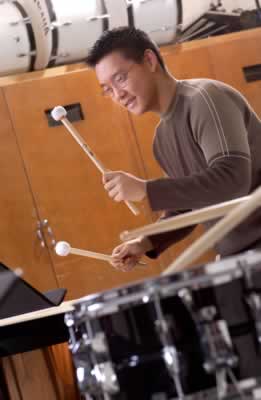 Cleaning and Maintaining Your Snare Drum:
- Clean the stand with glass cleaner and a rag.
- Clean the practice pad with a damp rag. Use a scrub pad if needed.
- Clean the batter head (top head) with a damp rag. Use a scrub pad if needed.
- Clean the chrome on the drum with glass cleaner.
- Set-up the stand and be sure all tightening screws and moving parts are working.
- Check the drum for dents, damage and missing parts.
- Check the heads for dents and damage.
- Check the lug nuts for proper tension. If they seem to need adjusting, ask your instructor for help.
- Check the snare and the snare throw-off. Move the throw-off back and forth and see if the snare is functioning properly.
- Check the string or tape used to attach the snare.
- Put the drum on the stand to insure proper fit.
Cleaning and Maintaining Your Percussion Kit:
- Clean the stand with glass cleaner and a rag.
- Clean the practice pad with a damp rag. Use a scrub pad if needed.
- Clean the bells with glass cleaner and a rag.
- Clean the frame with a damp rag if needed.
- Set-up the stand and be sure all tightening screws and moving parts are working.
- Check the practice pad and mount on stand to insure proper fit.
- Check the bells and mount on stand to insure proper fit.
- Make sure that each bar is attached to the frame. (Check for missing nails.)
- Inspect frame for cracks.
Brass
Basics
 Basics about: cornets, trumpets, French horns, trombones, baritones and tubas. A brass instrument is played as a musician blows air into a metal mouthpiece. (This is sometimes called "buzzing" into the mouthpiece.) Brass instruments are typically constructed of yellow brass - which is about 75 percent copper - and finished with epoxy lacquer for a durable, clear finish.
How are different notes and sounds produced?
- Trumpets and cornets usually play the higher notes in the brass family. These instruments have three valves (or pistons). Playing different combinations of these valves controls the air flow. Along with the player's lip and mouth position (called embouchure), valve combinations determine the pitch of the sounds.
- French horns play the middle range notes for this family. Like trumpets and cornets, the sounds made by the French horn are controlled by three rotary valves and the shape of the player's lips and mouth.
- Trombones, along with baritones, usually play the lower notes in the brass family. Trombones use a long movable "slide section" to change pitch, while the baritone uses a three-valve system, much like a trumpet. As with other members of the brass family, the shape of the player's mouth and lips is critical for creating good tone and producing changes in pitch.
- Tubas play the very lowest notes in the band or orchestra. Like trumpets and baritones, tubas use a three-valve system. This valve system along with changes in a player's mouth and lip shapes create different tones and pitches.
Accessories
Your music instructor may recommend some accessories. The following are just a few of the accessories available at Portman's Music. We can help you learn what you may need and how to use them. We have pre-assembled educator approved care kits.
For trumpets, cornets, French horns, baritones and tubas: cleaning brushes, lacquer polishing cloths, mutes, tuning slide grease, valve casing rod, and valve oil.
For trombones: cleaning brushes, lacquer polishing cloths, slide cleaning rod, slide cream and slide oil. Cleaning Brushes: Available in various sizes to clean internal tubing, valve casings and mouthpieces.
Mouthpiece pouches: Will keep the mouthpiece from getting nicked or scratched. If the rim of the mouthpiece is rough it can irritate the player. If the tapered end becomes dented, the mouthpiece will not fit into the horn tightly.
Mutes: Used to create different sound effects. They fit into the bell of the instrument. Most players start with a straight mute. Because mutes can also be used to quiet the horn, they are sometimes called practice mutes.
Polishing cloths: Used to clean and polish the finish on brass instruments.
Trombone slide cream: Slide cream is like cold cream in texture, which players like because it is not as messy as slide oil. The cream can also be refreshed with a spray of water.
Trombone slide oil: Trombone slide oil is used to lubricate the trombone slide. A slide that does not move freely is very difficult to play.
Tuning slide grease: Tuning slide grease is a thick substance that allows the slide to move freely without falling out of the horn.
Valve oil: Valve oil is used to lubricate valved instruments.
Cleaning
Below you will find info on cleaning your Trumpet, Cornet, French Horn, Trombone, or Baritone.
CLEANING YOUR TRUMPET OR CORNET:
Every time you play:
- Oil the valves by putting a small amount of valve oil on the piston while it is half out of the casing. Make sure to rotate the valve in the casing until the guides click into place before screwing the top valve caps back on.
- After playing, wipe the instrument down with the lacquer polish cloth to remove dirt and fingerprints.
Every Month:
- Take the instrument apart to bathe it, removing the three pistons, the bottom valve caps, and all the slides. Wash the slides and instrument in lukewarm water with mild dish soap, using the bore cleaner to scrub the lead pipe and the valve casing brush to scrub the casings. Use the mouthpiece brush to clean the bore of the mouthpiece. Wash the pistons under the tap using dish soap, being careful not to allow the felts under the finger buttons to get wet. Allow all parts to dry thoroughly, then grease the slides with tuning slide grease and reapply oil to the valves. Make sure to put the correct piston into the correct casing; generally, both parts are numbered.
- Inspect the instrument for dents. Any dent that is deeper than 10% of the thickness of the tube at that point should be brought in to Portman's Music to be rolled out.
Every Year:
- Bring the instrument to Portman's Music for an annual service.
General tips:
- Never store music or accessories over top of the instrument in the case; the second valve slide is very vulnerable to dents.
- If the mouthpiece is tapped while on the instrument, or the bore on the mouthpiece is not round, it can become stuck. Never try to remove a stuck mouthpiece with pliers; Portman's Music will remove it for you free of charge.
CLEANING YOUR FRENCH HORN:
Every time you play:
- Oil the rotors by unscrewing the valve cap and putting a drop or two of oil underneath. Replace the valve caps and work the keys up and down to distribute the oil. Put a drop of two in the underside of the valve as well, in the seam where the axle and its bearing meet.
- After playing, make sure to remove all excess water from the instrument, and wipe the exterior down with the lacquer polish cloth to remove dirt and fingerprints.
Every month:
- Take the instrument apart to bathe it, using lukewarm water and mild dish soap. Scrub the lead pipe with the bore cleaner. Use the mouthpiece brush to clean the bore of the mouthpiece. Allow all parts to dry thoroughly, then grease the slides with tuning slide grease and reapply oil to the rotors.
- Inspect the instrument for dents. Any dent that is deeper than 10% of the thickness of the tube at that point should be brought in to Portman's Music to be rolled out.
Every year:
- Bring the instrument in to Portman's Music for an annual service.
General tips:
- Never store accessories or music on top of the instrument inside the case; keep them inside accessories compartments or in a separate bag.
- If the mouthpiece is tapped while on the instrument, or the bore on the mouthpiece is not round, it can become stuck. Never try to remove a stuck mouthpiece with pliers; Portman's Music will remove it for you free of charge.
CLEANING YOUR TROMBONE:
Every time you play:
- If the slide is slightly sticky, mist it with water from the spray bottle.
- After playing, wipe down the instrument with the polish cloth to remove dirt and fingerprints.
Every week:
- Remove the inside slide from the outside slide and apply a small amount of slide cream to the stockings at the end of the inside slide. Use the spray bottle to mist water over the stockings and slide. Reinsert the inside slide and run it up and down the outside slide to distribute the cream.
Every month:
- Take apart the bell, tuning slide, inside slide, and outside slide to bathe the trombone. Using lukewarm water and dish soap, wash the outside and remove any slide cream that has built up on the slide. Use the bore cleaner to clean inside the bell portion and both slides. Use the mouthpiece brush to clean the bore of the mouthpiece. Allow the instrument to dry thoroughly before putting it back together. Reapply the slide cream as you would every week, and apply tuning slide grease to the tuning slide.
- Inspect the instrument for any dents. Any large dents should be brought to Portman's Music to be rolled out.
Every year:
- Bring the instrument to Portman's Music for an annual check.
General tips:
- Any dent in the slide will affect how it works; be very careful when handling it, and always make sure that the slide is clamped into the case before you close it.
- You should only apply slide cream to the stockings of the inner slide, and there should never be so much on that you can see white cream on the slide.
- Your slide lock will help prevent the slide from falling off the instrument, so put it on whenever you are not using it. Be careful not to twist it too tight; turn it only enough to hold the slide.
CLEANING LOW BRASS:
Every time you play:
- Apply valve oil by lifting the piston partway out of the casing and applying oil to the piston. Drop the valve back into the casing and rotate it until you hear the valve guides click into place before you screw the top valve caps back on.
- After playing, wipe the instrument down with your lacquer polish cloth to remove dirt and fingerprints.
Every month:
- Take the instrument apart to bathe it, removing the three pistons, the bottom valve caps, and all the slides. Wash the slides and instrument in lukewarm water with mild dish soap, using the bore cleaner to scrub the lead pipe and the valve casing brush to scrub the casings. Use the mouthpiece brush to clean the bore of the mouthpiece. Wash the pistons under the tap using dish soap, being careful not to allow the felts under the finger buttons to get wet. Allow all parts to dry thoroughly, then grease the slides with tuning slide grease and reapply oil to the valves. Make sure to put the correct piston into the correct casing; generally, both parts are numbered.
- Inspect the instrument for dents. Any dent that is deeper than 10% of the thickness of the tube at that point should be brought to Portman's Music to be rolled out.
Every year:
- Bring the instrument to Portman's Music for an annual service.
General tips:
- Never store music or accessories over the instrument inside the case; the second valve slide is very vulnerable to damage.
- If the mouthpiece is tapped while on the instrument, or the bore on the mouthpiece is not round, it can become stuck. Never try to remove a stuck mouthpiece with pliers; Portman's Music will remove it for you free of charge.
How-to clean instruments playlist
Woodwind
Basics
 Basics about: piccolos, flutes, oboes, bassoons, clarinets, saxophones.
As their name implies, woodwind instruments were originally made of woods. Today, however, these instruments are also made out of many other materials that provide the sound quality musicians desire. For example, flutes designed for beginners are made of nickel silver, which is very durable. Clarinets for new musicians are manufactured of a synthetic material that is less likely than wood to be affected by humidity and temperature changes.
Woodwind instruments have many "keys," which are the levers that control the mechanisms that create the notes. Beginner instruments are designed with various adaptations to help make playing easier for young beginners.
Piccolos, English horns and bassoons are not typically played by beginners. Please check with your band or orchestra instructor for any questions you may have about these instruments.
How are different notes and sounds produced?
- Flutes play the highest notes in a band or orchestra. Air is blown across the mouthpiece (specifically, over the lip plate). As the player depresses keys and changes his or her mouth and lip shapes (called embouchure), notes and sound quality will change.
- Clarinets and saxophones can play a wide range of notes in a band or orchestra. In these instruments, musical notes are made by blowing on a "reed" that is mounted on the mouthpiece. (The oboe especially has a very distinctive sound - it has a double reed in place of a mouthpiece.) As the reed vibrates, air vibrates in the instrument. A combination of pressing the "keys" and changing the shape of the mouth or lips will change notes.
Accessories
Your music instructor may recommend some accessories. The following are just a few of the accessories available at Portman’s Music. We can help you learn what you may need and how to use them.For clarinets: ligatures, mouthpiece brushes, mouthpiece caps, reeds, reed holders, swabs, and cork grease
For flutes: cleaning rods, and polishing cloths.
For oboes: swabs and cork grease.
For saxophones: lacquer polishing cloths, ligatures, mouthpiece brushes, mouthpiece caps, neck straps, reeds, reed holders, and swabs.
Flute cleaning rods: Cleaning rods are used with a non-lint cloth, to remove the moisture that collects inside the flute after playing. Cleaning the inside of a flute helps to preserve the pads, and keeps the flute in good playing condition.
Flute polishing cloths: The cloth is used to remove fingerprints and keep the flute looking its best.
Flip folders: Flip folders secure your music on your lyre in marching or pep band, allowing you to flip the pages of your music.
Lyre: Used by players who are in pep band or marching band, lyres attach to the instrument. The lyre serves as a temporary music stand for players who are moving or who are in tight quarters.
Mouthpiece brushes: Mouthpiece brushes are used to clean the mouthpiece in routine cleaning of your instrument.
Mouthpiece caps and ligatures: The mouthpiece cap protects the tip of the mouthpiece in storage. The ligature holds the reed in place on the mouthpiece. A good ligature should hold the reed firmly and allow the reed to vibrate.
Oboe swabs: These items are used to control moisture in the oboe after each playing.
Oboe reeds: Oboe reeds come in different strengths: soft, medium soft, and hard. See your instructor for guidance.
Reed holders: After playing, the reed should be removed from the mouthpiece and allowed to dry flat. The reed holder allows the air to move around the reed to dry it out.
Reeds: Reeds come in a variety of strengths or thicknesses. The numbering systems are not standard from one manufacturer to another. Beginning students should usually start with a #2 or #2 1/2.
Saxophone polishing cloths: Most saxophones are made of brass and coated with a lacquer finish, so you can use a damp cloth or a lacquer polishing cloth to remove fingerprints and to polish your instrument.
Saxophone neck straps: There are a variety of neck straps available for the player to make playing more comfortable.
Swabs: These are drop-through swabs made of chamois, synthetic chamois or cotton cloth, and they are used to remove moisture from inside the clarinet after playing. It should be used each time the instrument is put away.
Cleaning
Below you will find info on cleaning your Flute, Oboe, Clarinet and Saxophone.CLEANING YOUR FLUTE:
Your flute care kit comes with a flute swab and a silver polish cloth. Using these on a regular basis will keep your flute working well.
Every time you play:
- When you assemble the instrument, rotate the joints to slide them together; wiggling the joint will loosen it.
- After playing, clean the inside of your flute with the swab. Make sure to clean the body, foot joint and head joint.
- After playing, wipe the outside of your flute down with a soft cloth or the silver polish cloth. A quick wipe of the body, head, and foot will keep the instrument clean and free of tarnish. Do not polish the key work or rub the cloth up to the edges of the pads.
- Examine your flute for screws coming loose or keys that do not open or close correctly. If you find any, take the instrument to Portman’s Music for adjustment.
- If the flute's key work is noisy or sticky, bring it to Portman's Music for a quick check and oiling.
- Bring your flute in to Portman's Music for a yearly checkup and headjoint service.
- Always make sure your flute is warm before you start to play.
- Store the polish cloth outside of the case (in a backpack or binder) to prevent damage to the flute mechanisms.
- If the whole instrument or certain notes suddenly become much more difficult to play, it is likely that a pad or key is leaking; bring the instrument in for an assessment.
After every time you play:
- Remove the reed from the instrument and put it in your reed guard.
- Turn the instrument upside down and drop the string of the oboe swab through it from the bell end to the reed end. Slowly and gently pull the swab through the instrument. Wrap the swab up and store it in the accessories pocket of your case or tucking into the bell of the oboe.
- If the joints are difficult to put together, apply a small amount of cork grease to the cork of each joint.
- Check your instrument for screws coming loose and keys that are not opening or closing properly. If there are any, bring the instrument in to Portman's Music for an adjustment.
- If you see buildup of cork grease and lint in and around the keywork, use the key brush to remove it.
- If your keys are sticky or noisy, bring the oboe to Portman's Music for a check and oiling.
- Bring the oboe to Portman's Music for an annual check.
- Oboes have two bridge keys between the top and bottom joints which are very vulnerable. Be careful not to bend or twist these when assembling the instrument.
- The reed will make a big difference to the sound of the oboe. Always soak the reed well before playing, and never play on a broken reed.
- Be careful not to store music or supplies over the keys of the instrument in the case.
- If the whole instrument or certain notes suddenly become more difficult to play, a key or pad is probably leaking. Bring the instrument to Portman's Music for an assessment.
After every time you play:
- Remove the reed from the mouthpiece and store it in the reed guard.
- Remove the mouthpiece from the remainder of the instrument. Turn the instrument upside down and drop the string of the hanky swab through from the bell to the barrel. Gently and slowly pull the swab through the instrument. Wrap the swab up and store it in the accessories pocket of your case or tuck it in the bell of your instrument.
- If the cork joints of your instrument are difficult to put together, apply a small amount of cork grease on the cork of each joint.
- If your mouthpiece has some buildup inside the chamber, use warm water and the mouthpiece brush to clean it. A soft, old toothbrush can also be used for this cleaning. Be careful not to scratch the inside of the mouthpiece.
- Check your clarinet for screws coming loose or keys that do not open or close correctly. If you find any, bring the instrument in to Portman's Music for adjustment.
- If your clarinet's keys are noisy or sticky, bring the instrument in to Portman's Music for a check and oiling.
- Bring your clarinet to Portman's Music for an annual check and cleaning.
- Be careful not to store music or supplies over the keys of the instrument in the case.
- Reeds make a big difference to the sound of the instrument. Never play on a cracked or chipped reed. Rotate between three or four reeds at a time so that you always have one that works, and replace your reeds every few weeks to a month.
- Always check the bridge key between the two long joints of the instrument to be sure they align properly.
- If the whole instrument or certain notes suddenly become much more difficult to play, it is likely that a pad or key is leaking; bring the instrument in for an assessment.
After every time you play:
- Take the reed off the mouthpiece and store it in your reed guard.
- Take the neck off the body of the saxophone and pull the neck swab slowly and gently through from the body end to the mouthpiece end.
- Pull the saxophone body swab slowly and gently through the body of the instrument from the bell end to the neck end. Replace the endplug in the neck end of the body.
- Wipe the body and neck with your lacquer polish cloth. Be careful not to rub the cloth against the edges of the pads.
- If the mouthpiece is hard to put on, use a small amount of cork grease on the neck cork.
- If your mouthpiece has buildup in the chamber, use the mouthpiece brush and warm water to clean it. You can also use an old, soft toothbrush. Be careful not to scratch the inside of the mouthpiece.
- Check your saxophone for screws coming loose or keys that won't open or close properly. If you find any, bring it to Portman's Music for an adjustment.
- If your keys are noisy or sticky, bring the instrument in for a check and oiling.
- Bring your saxophone to Portman's Music for an annual check and neck service.
- Be careful not to store supplies or music over the keys of the instrument.
- Reeds make a big difference to the sound of the instrument. Never play on a cracked or chipped reed. Rotate between three or four reeds at a time, and always replace your reeds every month or so.
- If the instrument or certain notes suddenly become hard to play, it is likely a pad or key is leaking. Bring the saxophone in for an assessment.